A pizzeria in Portland ran a Facebook giveaway in October 2025: free dinner for two, picked from comments on a "tag a friend you'd bring to dinner" post. The owner scrolled through 837 comments on his phone after closing, paused at one, and announced the winner the next morning.
The winner turned out to be his next-door neighbor. The pick was genuinely random — he hadn't even recognized the name until after the announcement. Didn't matter. By noon, the page's comment section was a wall of accusations: "Convenient that your friend won." "This is rigged. We're done." The restaurant pulled the post, comped a few angry regulars, and learned the hard way that appearing random isn't enough on Facebook.
This is how most Facebook giveaways end — not with fraud, but with the appearance of it. The fix is a winner-selection method anyone in your audience can verify themselves. This guide is the complete playbook for picking a Facebook giveaway winner in 2026 that holds up to scrutiny: three picking methods compared, Meta's Page-specific compliance rules, audit-trail mechanics, and a cross-platform strategy for brands running giveaways on Facebook and Instagram simultaneously.
TL;DR
- Manual winner picking is the #1 cause of "rigged" accusations on Facebook — regardless of whether the pick was actually random.
- Use a Facebook comment picker that produces a public proof URL anyone can verify without an account.
- Meta's Pages, Groups, and Events Policies apply to every Facebook giveaway, including the mandatory disclaimer.
- Most modern brands run the same giveaway on Facebook AND Instagram — the same compliance checklist works for both.
- Save the eligible-entry list and proof URL for at least 90 days in case of disputes.

Why Facebook Picking Methods Get Scrutinized Harder Than Instagram's
Facebook giveaways face heavier scrutiny than Instagram giveaways for four structural reasons:
1. Comment threading. Facebook comments nest with replies, reactions, and edits. A 500-comment post is functionally a 1,200-entry post once you count threaded replies. Manual scrolling misses comments easily — and any visibly missed comment becomes proof of bias to a frustrated entrant.
2. Older audience demographics. Facebook's user base skews older than Instagram's, and older audiences scrutinize winner picks more carefully. Comment sections on Facebook giveaways routinely include detailed questions about selection methodology that you'd rarely see on TikTok or Instagram.
3. Page transparency tools. Anyone visiting your Facebook Page can scroll through every previous post, every previous giveaway, and every previous winner. Patterns are catchable. Picking your own audience members repeatedly — even by coincidence — creates a visible trail of "the same names keep winning."
4. Share mechanics drive higher entry volumes. Facebook's share function works better than Instagram's, so giveaways routinely surface to 5-10× more entrants. More entries = more pressure = more visibility on the pick = more accusations if anything looks off.
The combination is why a Facebook giveaway needs not just a random pick, but a verifiably random pick.
Three Ways to Pick a Facebook Giveaway Winner
Three methods, ranked by how well they survive contact with a skeptical audience:
1. Manual scrolling. You scroll through comments, pause, pick. 45+ minutes for 1,000 entries. Zero defensibility. Even genuinely random picks can't be proven, and any account-adjacent winner triggers rigging accusations. The Portland pizzeria in the opening of this article used this method. Don't.
2. Random.org's list randomizer. Free, defensible for small giveaways. The workflow: manually export your eligible comments to a list, paste each username into random.org, screenshot the result. The catch is the manual export — you have to filter for entry compliance (tag-a-friend met, keyword match, no duplicates) before pasting, and any error in that filtering step is contestable. Workable for under 200 entries.
3. A dedicated comment picker with proof URL. The 2026 standard for any Facebook giveaway over 200 entries. A dedicated tool pulls every comment from the post URL, applies entry filters server-side (tag-a-friend requirement, keyword match, duplicate removal, spam detection), and draws a winner with a cryptographically seeded random algorithm. The seed publishes on a public proof URL anyone can verify — they can rerun the same seed against the same comment pool and arrive at the same winner. Mathematical proof, not a screenshot.
What to Look for in a Facebook Comment Picker
If you're evaluating tools, four features separate professional pickers from glorified random-number generators:
- Server-side comment fetching. The tool pulls comments via Meta's API or scraping rather than asking you to paste them. Eliminates manual-curation errors.
- Entry filters. Tag-a-friend verification (does the tag exist?), keyword matching, dedupe-by-username, spam filtering. Each filter you can apply pre-draw is a layer of defensibility post-draw.
- Seeded random algorithm with a public proof URL. The seed is the audit trail. Without it, "we used a random tool" is unfalsifiable. With it, the entire draw is reproducible by anyone.
- Multi-winner support. For giveaways with first/second/third place or guaranteed backup winners. Multi-winner from the same seed is more defensible than running the draw twice.
If a tool doesn't offer all four, you're trading defensibility for convenience.
A Facebook giveaway without a verifiable proof URL is one frustrated entrant away from a public accusation you can't disprove.
Facebook's Promotion Rules for Pages
Meta's Pages, Groups, and Events Policies govern Facebook giveaways the same way they govern Instagram giveaways — most of the Instagram giveaway compliance rules apply to Facebook directly. Four Facebook-specific requirements:
1. Run the promotion from a Page. Personal profile giveaways are banned. Use a Page (Business, Brand, or Public Figure) or a Group (with admin permission and proper disclosure). Meta enforces this automatically — promotion posts from personal Timelines are removed within 24-48 hours.
2. Publish official rules at launch. Same as Instagram: eligibility, dates with time zone, prize, selection method. Facebook's caption character limit is generous (63,206 characters) so you can typically include the full rules in the post itself. For longer rules, link to a dedicated rules page from the post.
3. Include the mandatory disclaimer. Verbatim:
"This promotion is in no way sponsored, endorsed or administered by, or associated with, Facebook."
Pin it as the first comment, or include it at the bottom of the post caption. Paraphrased versions fail Meta's automated compliance checks the same way they do on Instagram.
4. Don't require personal Timeline shares as the entry mechanic. Share-to-your-Story is more flexible on Facebook than on Instagram — you can use sharing as a bonus entry method. You cannot make it the primary requirement. Meta cannot verify off-Page shares, so "share this post to enter" creates a rule you can't enforce, which makes the draw contestable.
For multi-page collaboration giveaways (you and a partner brand co-host), both pages must be Business or Brand pages and the rules must specify which page handles winner selection and prize fulfillment.
How to Export Facebook Comments for an Audit Trail
Even with a dedicated picker, save the eligible-entry list as a CSV. The Texas Attorney General's office, the FTC, and disputed-entrant lawsuits all care about the same thing: can you produce the list of everyone who was eligible at draw time?
Three options for Facebook comment export:
- Manual screenshots. Workable for under 100 entries. Capture the comment thread before drawing. Date and timestamp visible in the screenshot.
- Page Insights export. Facebook Pages with Business access can export engagement data from Meta Business Suite, including comment-level data. Limited filtering options.
- Browser-based scrapers. Browser extensions exist that export Facebook comment threads to CSV. Verify they handle threaded replies and don't violate Meta's automated traffic policies.
ExportComments currently supports Instagram, TikTok, YouTube, and X comment exports — Facebook is on our roadmap for 2026. For Facebook specifically right now, a screenshot-plus-CSV approach is the simplest audit trail. Save both the screenshot and the CSV in cloud storage for 90 days minimum after the giveaway ends.
Running Giveaways on Facebook and Instagram Together
Most modern brands cross-post the same giveaway on both Facebook and Instagram. Meta's Business Suite makes this near-automatic, and the audiences barely overlap — Facebook reaches an older, slightly different demographic than Instagram, so cross-posting roughly doubles your total entry count for the same content effort.
The compliance checklist is nearly identical across platforms:
- Same mandatory disclaimer (with platform name substituted)
- Same official rules requirements (eligibility, dates, prize, method)
- Same ban on tag-yourself-in-photos
- Same restriction on personal Timeline mechanics
- Same requirement to run from a Business/Brand/Creator account
What differs is the winner pick. You'll need to decide whether to pick:
- One winner across both platforms — combine all eligible entries from FB + IG into one pool, draw once. Best for prize logistics. Requires a tool that handles cross-platform entry pools.
- One winner per platform — separate draws, separate winners. Doubles your prize cost but is operationally simpler. Most cross-platform giveaways use this structure.
For the Instagram side, the Instagram Comment Picker generates a verifiable proof URL for the IG draw. For the Facebook side, use a dedicated Facebook picker that produces an equivalent proof. State the picking methodology for each platform in your official rules.
Running cross-platform giveaways? Pick your Instagram winner with our free Instagram Comment Picker — verifiable proof URL, no signup required. Facebook support is coming soon.
→ Open the Instagram Comment Picker
Multi-Winner Draws and Backup Winners
For giveaways with more than one prize tier, two structural decisions matter:
1. How are the prizes ranked? First-place, second-place, third-place draws should pick winners in sequence from the same seed so the order is auditable. Random three-winners-at-once draws are simpler but less defensible if a winner challenges their position.
2. Are backup winners pre-drawn or drawn on demand? Pre-drawing 2-3 backups from the same seed at the same time as the primary draw is the audit-friendly approach. If the primary winner doesn't respond within 48 hours, the next-seed-position backup takes their place — and the audit trail shows the backup was determined before anyone knew the primary wouldn't respond.
The 48-hour winner-response window is the practical standard. State it in your official rules. Without it, you're either holding giveaways open indefinitely or making ad-hoc decisions about when to switch to a backup — both of which are contestable.
Common Facebook Giveaway Mistakes to Avoid
Seven mistakes that account for roughly 80% of Facebook giveaway disputes:
- Picking manually after promising "random." The single biggest cause of rigging accusations. If you publish "random selection" in your rules, the method has to be mechanically random, not just intent-random.
- Missing the Facebook disclaimer. Same enforcement as Instagram — a missing "not associated with Facebook" line gives Meta grounds to pull the post if reported.
- Running the promotion from a personal Timeline. Banned by Meta's policies. Posts removed within 24-48 hours.
- Requiring shares to personal Timelines as the entry mechanic. Unverifiable from the platform side, makes the draw contestable.
- Not publishing the closing time zone. "Closes Friday at midnight" with no time zone is the most-contested clause in giveaway disputes.
- No backup winner provision. 8-12% of winners don't respond within the claim window. Without a pre-drawn backup, you're extending deadlines arbitrarily.
- Deleting the giveaway post after the winner is announced. Removes the audit trail. If anyone later disputes the outcome, you have no public record of the rules, the entries, or the announcement.
Frequently Asked Questions
What's the best Facebook comment picker for giveaways? The best Facebook comment picker generates a public proof URL that anyone can verify without an account. Look for tools that fetch comments server-side, apply entry filters (tag-a-friend verification, keyword match, dedupe), and publish a cryptographic seed alongside the winner. Without a proof URL, "random selection" is unfalsifiable — and unfalsifiable claims are exactly what gets challenged in giveaway disputes.
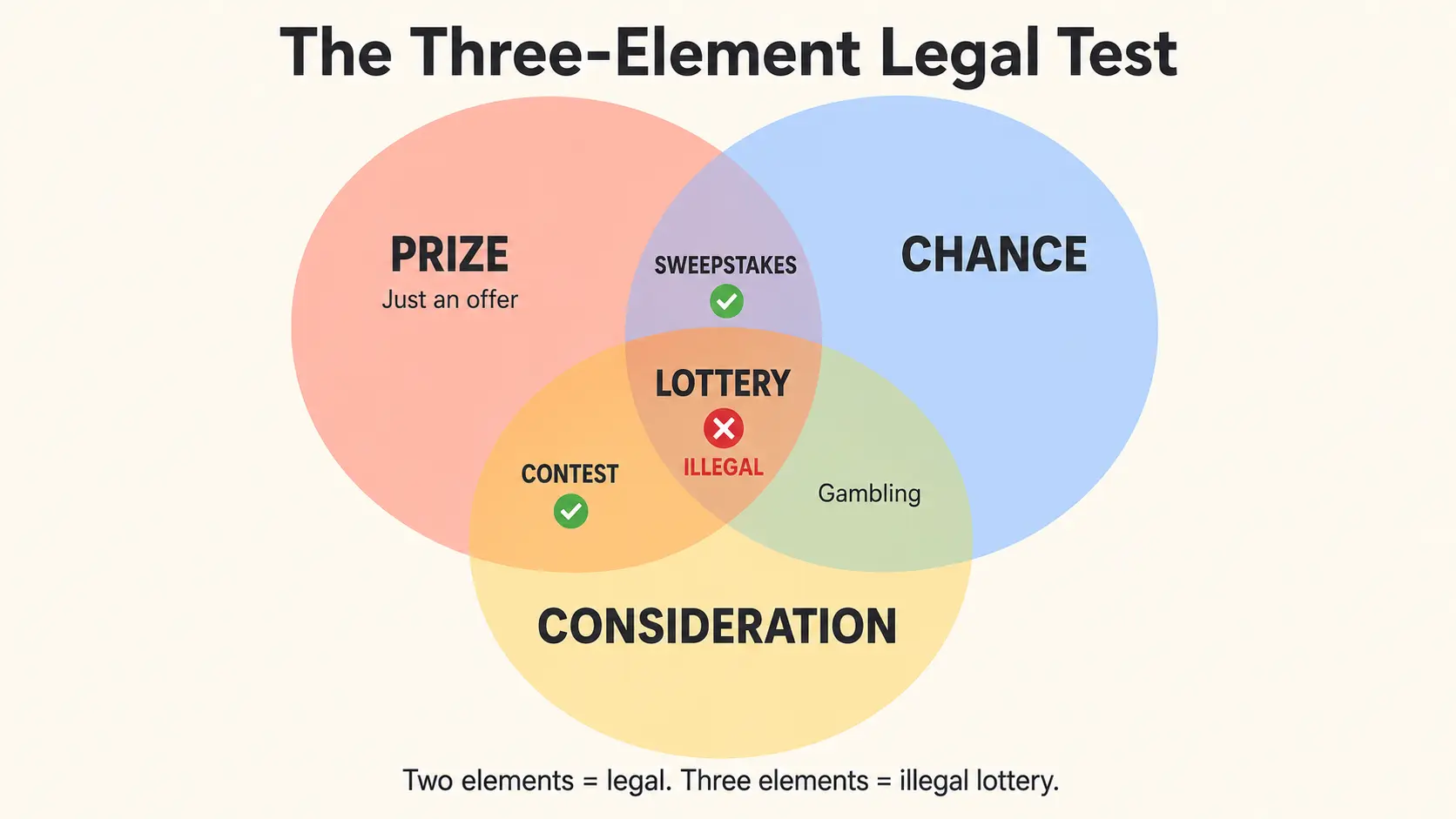
Is it legal to run a giveaway on a Facebook Page? Yes, as long as you follow Meta's Pages, Groups, and Events Policies (run from a Page, publish official rules, include the mandatory disclaimer) and the underlying structure isn't a lottery. Most Facebook giveaways qualify as sweepstakes — for the full legal breakdown, see sweepstakes vs giveaway vs contest.
How many comments can a Facebook comment picker handle? Quality tools handle 5,000-50,000 comments per draw. Beyond 50,000, performance degrades and Meta's API rate limits start to interfere. For giveaways expected to exceed 50,000 entries, plan to draw in segments or use a tool with enterprise-tier API access.
Can I pick a winner from a Facebook Group? Yes, if you're an admin of the Group and the Group's rules permit promotions. Group giveaways follow the same compliance checklist as Page giveaways, with one addition: state in your rules that the promotion runs within the Group, not from Facebook itself. The mandatory disclaimer still applies.
Does a Facebook comment picker work for shares and reactions, or only comments? Comment-only is the standard. Facebook's API exposes comment data to authorized tools, but share data and reactions are either unavailable or restricted to Page Insights. If you want to incorporate shares or reactions into the entry mechanic, treat them as bonus entries you can't reliably verify — not as the primary entry mechanism.
Do I need a Facebook Business account to run a giveaway? For Page-based giveaways, yes — your Page must be a Business, Brand, or Public Figure Page (not a personal profile converted into a Page). For Group-based giveaways, the Group can be standard, but you must be an admin. Personal profile giveaways are banned by Meta's policies regardless of follower count.
What's the difference between a Facebook comment picker and an Instagram comment picker? The underlying logic is identical — pull eligible comments, apply filters, draw with seeded random, publish a proof URL. The platform-specific differences are in comment threading (Facebook has deeper reply structures), API access (different rate limits and permissions), and disclaimer text ("Facebook" vs "Instagram" in the mandatory disclaimer). A tool built for one platform doesn't automatically work on the other.
How do I pick multiple winners from one Facebook giveaway? Best practice: use a tool that supports multi-winner draws from a single seed, drawing winners sequentially with auditable order (first, second, third). State the prize hierarchy in your official rules. For 3-5 backup winners alongside the primary winner, pre-draw all positions at the same time so the backup order is determined before anyone knows it'll be needed.
How to Run a Trustworthy Facebook Giveaway in 2026
The core decision is the picking method. Manual scrolling generates rigging accusations. Random.org works for small draws but leaves the eligibility-filtering step manual and contestable. A dedicated comment picker with a public proof URL is the only method that survives a determined skeptic in your audience.
When you're ready to launch, run the step-by-step playbook for the full execution flow (the framework works for Facebook too), check the Meta compliance checklist for platform rules, and use the Instagram Comment Picker for the Instagram side of cross-platform giveaways. Agencies running multiple promotions a month can compare plans for multi-winner draws, audit logs, and white-label proof pages.
Related Reading
- Instagram Comment Picker — Pick a Verifiable Random Winner — the tool referenced throughout this guide.
- How to Run an Instagram Giveaway: Complete 2026 Guide — the full six-step playbook applies to Facebook too.
- Instagram Giveaway Rules 2026: Complete Meta Compliance Checklist — Meta's Pages, Groups, and Events Policies apply to both platforms.
- Sweepstakes vs Giveaway vs Contest: The Legal Difference — the legal framework behind every prize promotion.
- How to Export Instagram Comments — Complete Guide — save the eligible-entry list as proof.