Two days before Black Friday 2025, a beauty brand in Brooklyn launched what should have been their biggest giveaway of the year — a $1,200 skincare bundle, a celebrity partnership, 40,000+ projected entries. By day three, Meta had pulled the post.
Their violation: they'd asked entrants to "share this giveaway to your Instagram Story for an extra entry." A rule that sounds harmless. A rule that triggers Meta's automated promotion-policy detection inside 72 hours. They lost the post, the partnership goodwill, and any chance of running another promotion from that account for the next 30 days.
This is the compliance checklist that prevents that outcome. Four Meta-enforced rules, the FTC disclosure requirements, the verbatim disclaimer text, and a pre-launch audit you can run in five minutes — every Instagram giveaway rule that actually carries enforcement weight in 2026.
TL;DR
- Meta enforces four rules: take responsibility, publish official rules, include the disclaimer, ban inaccurate tagging.
- The mandatory disclaimer must be word-for-word — paraphrasing fails compliance checks.
- "Share to your Story" as a hard requirement is the most common violation, and Meta detects it within 72 hours.
- FTC requires
#addisclosure on any influencer-promoted giveaway in the US.- Save your eligible-entry list and proof URL for 90 days minimum — disputes happen.

The Four Rules Meta Actually Enforces
Meta's Pages, Groups, and Events Policies govern every Instagram promotion. Most "rules guides" online list eight or ten things to do. Meta's actual policy contains four mandatory requirements — the rest is best practice. Knowing the difference is the difference between a giveaway that runs and a giveaway that gets pulled.
These are the rules Meta's compliance system can detect automatically and act on without human review.
Rule 1: Take Full Responsibility for Your Promotion
Meta's position is unambiguous: Instagram does not run your promotion, you do. Every consequence — legal, tax, prize-fulfillment, disputes — sits with the promoter.
In practice, this means three things must appear in your published rules:
- Eligibility criteria. Minimum age, country restrictions, and excluded participants (employees, family, contractors).
- A clear start and end date and time. Include the time zone — "Closes May 27, 2026 at 11:59 PM EST" leaves no ambiguity. "Closes Friday at midnight" is contestable.
- The exact prize. Specify what the winner receives, including any cash-equivalent value (the IRS will care if it's over $600 in the US).
- The winner selection method. How the draw happens, when it's announced, and the response deadline before a backup winner is chosen.
If a regulator or a frustrated entrant takes you to small-claims court — and this happens more often than you'd expect with prizes over $500 — your published rules are the contract. Vague rules are unenforceable rules.
Rule 2: Publish Official Rules Before Launch
Meta requires the rules to exist at the time the promotion goes live, not after a complaint. Posting rules retroactively after a dispute is what flips a borderline giveaway into a policy violation.
You have three places to publish:
- In the post caption (best for short rule sets — fits the 2,200-character limit)
- As the first pinned comment (best for longer rules)
- On a dedicated landing page linked from the bio (best for high-stakes giveaways or anything over $500 in prize value)
For prizes over $200 or co-branded giveaways, export the comment list at draw time so you have an auditable record of every eligible entry. If someone later disputes the winner, you have the full entry pool with timestamps as evidence.
Vague rules aren't a soft violation. They're the gap a frustrated entrant uses to get the giveaway invalidated.
The most common rules-section mistake: omitting the time zone. A 6 PM PT deadline that someone reads as 6 PM ET is a four-hour entry window difference, and "I entered before the deadline in my time zone" is a real argument you'll have to address.
Rule 3: Include the Required Instagram Disclaimer
Non-negotiable. Word for word. Paraphrasing fails Meta's compliance checks.
Required disclaimer (paste verbatim into your rules): "This promotion is in no way sponsored, endorsed or administered by, or associated with, Instagram."
Place it in one of three locations:
- The bottom of your post caption
- The first pinned comment alongside your rules
- The dedicated rules landing page
Variations Meta's system flags as non-compliant include:
- "Not affiliated with Instagram" (too short — missing required elements)
- "This isn't an Instagram giveaway" (paraphrased — fails automated check)
- "Instagram is not responsible for this promotion" (rephrased structure)
The disclaimer applies even if you're a verified business with a million followers and a Meta Business Partner badge. There is no exemption.
Rule 4: Ban Inaccurate Tagging and Personal-Timeline Mechanics
Two related restrictions Meta has tightened in 2025 and continued enforcing through 2026.
No requiring inaccurate photo tags. You cannot ask entrants to tag themselves in a photo they aren't in. This includes tagging your brand's product photo as themselves, tagging the giveaway image, or tagging a stock photo of the prize. Meta's image-recognition system catches this within 24-48 hours of the post going viral.
No "share to your Story" as a hard requirement. This is the most-violated rule and the one that took down the Brooklyn beauty brand in the opening of this article. You can offer Story shares as a bonus or extra entry, but you cannot make them the entry mechanic itself. Meta cannot verify Story shares through any public API, so Meta's position is that a requirement they cannot audit cannot be a requirement.
What's allowed:
- ✅ Tag-a-friend in a comment (caps recommended at 1-3 tags)
- ✅ Follow + like + comment combinations
- ✅ Story shares as an optional bonus entry (not the primary mechanic)
- ✅ Branded hashtag use in your own post
- ✅ Repost to a Business or Creator account
What's banned:
- ❌ Tag yourself in a photo you aren't in
- ❌ Share to your personal Story as a hard entry requirement
- ❌ Run the promotion from a personal account (must be Business or Creator)
- ❌ Require entrants to post on their own Timeline as the entry mechanic
The personal Timeline rule is why your account type matters. Verify in Settings → Account → Account type that you're set to Business or Creator before launching.
FTC Disclosure: When You Need #ad
Meta's rules govern the platform. The FTC governs who's saying what. They overlap on Instagram giveaways.
The FTC requires clear disclosure whenever there's a material connection between a brand and a promoter. For giveaways, this means three scenarios trigger mandatory #ad or #sponsored disclosure:
- An influencer runs the giveaway on your behalf in exchange for free product, payment, or affiliate revenue.
- You're cross-promoting with a partner brand and either brand is compensated.
- An employee shares the giveaway without disclosing the employment relationship.
The hashtag must appear at the start of the caption — not buried at the bottom, not hidden in a list of 30 other tags. The FTC's 2023 endorsement guidelines are explicit: disclosure must be "clear and conspicuous."
For US-based promoters, prizes worth $600 or more also trigger a 1099-MISC reporting requirement. You'll need the winner's tax information before delivering the prize. Build that into your winner-claim process — most disputes happen at this step when winners don't realize they owe tax on the fair market value.
The 2026 Instagram Giveaway Compliance Checklist
Run through this before every giveaway launch. Five minutes, catches 95% of policy violations:
- Account is Business or Creator (not personal)
- Published official rules include eligibility, dates with time zone, prize details, and winner-selection method
- Rules visible at launch (caption, pinned comment, or linked landing page)
- Mandatory disclaimer included word-for-word
- No "tag yourself in a photo" mechanic
- No "share to Story" as hard requirement (bonus entry only)
- No "post to your Timeline" mechanic
- FTC disclosure (
#ad) at the start of any influencer- or partner-promoted post - Winner-selection method produces a verifiable proof URL
- Backup-winner provision in case primary doesn't respond within 48 hours
- Prize fulfillment timeline stated (especially for international shipping)
- Records (entry list, proof URL, screenshots) saved for 90 days minimum
The verifiable-proof-URL requirement is where most giveaways fail their own audit. The Instagram Comment Picker generates a public proof URL with the random seed, filtered entry pool, and selected winner — anyone in your audience can verify the draw without an account.
Compliance includes a verifiable winner pick. Pull every eligible comment, apply your entry filters, draw a winner with a seeded random algorithm, and publish a proof URL anyone can audit. Free, no signup required.
→ Open the Instagram Comment Picker
What Happens When You Violate the Rules
Meta's enforcement is automated, fast, and unforgiving. Three tiers, escalating with repeated violations:
Tier 1 — Post removal (first violation). The giveaway post is pulled. Engagement, comments, and follower growth vanish with it. Notification appears in the account's Support Inbox with the specific policy cited. No appeal in the first 24 hours; you can request review after.
Tier 2 — Account restrictions (repeated violations). Inability to run ads, create new promotion posts, or boost content for 30-90 days. This is account-level, not post-level — your entire promotional capability is paused.
Tier 3 — Permanent restrictions (pattern violations). Loss of Business/Creator account features. In severe cases, account deactivation. Rare, but it happens to accounts that violate after a Tier 2 warning.
There's also a non-Meta enforcement vector: state regulators. In the US, attorneys general in New York, California, Florida, and Rhode Island have specifically pursued social media giveaway promoters for missing rules, undisclosed odds, and prizes withheld from winners. Prize values over $5,000 trigger registration requirements in some states.
If you run more than two or three giveaways a year, particularly with prizes over $500, the cost of getting compliance right is trivial compared to the cost of getting it wrong.
Frequently Asked Questions
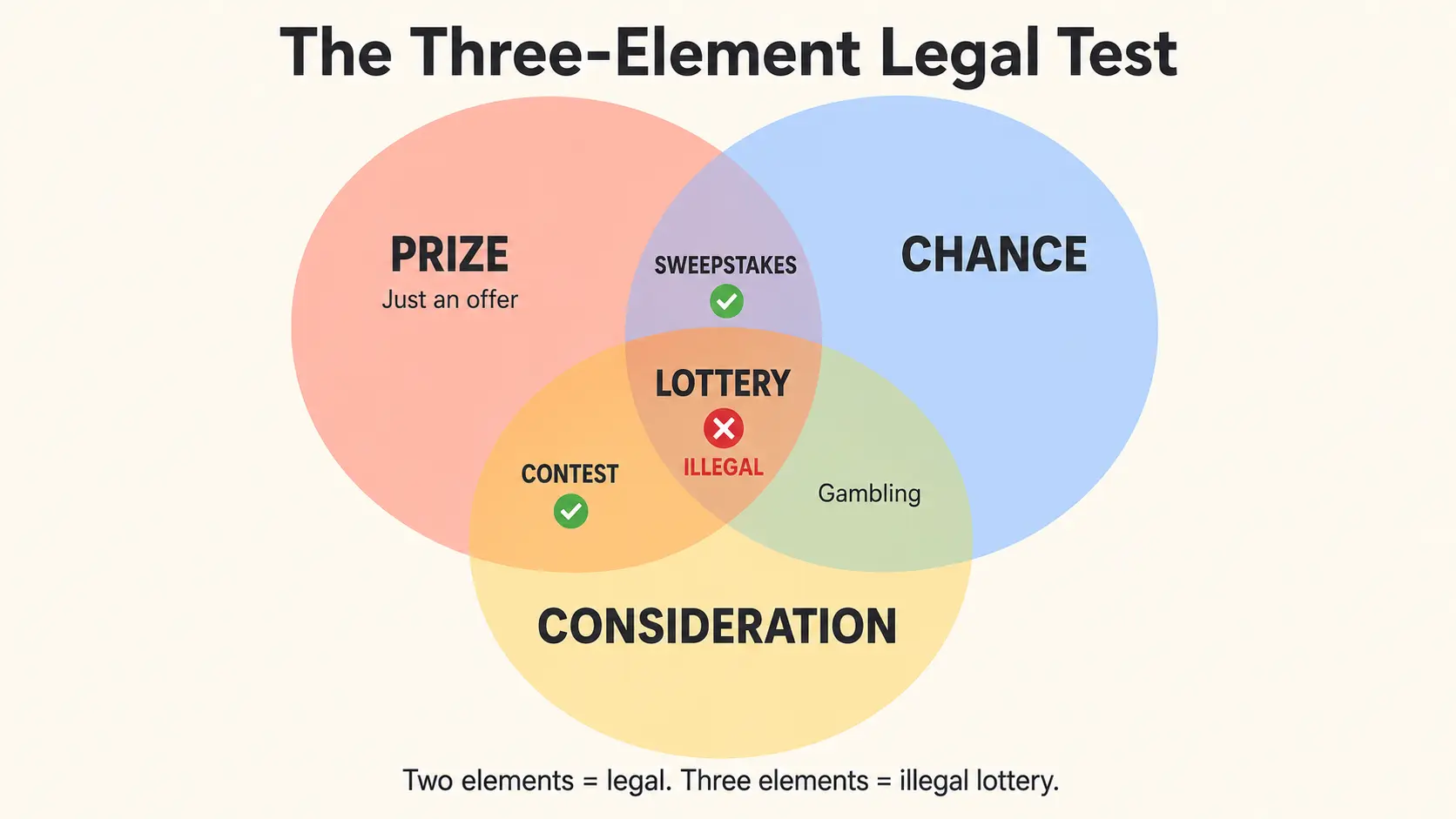
Are Instagram giveaways legal in 2026? Yes, in every major jurisdiction, as long as you follow Meta's Promotion Guidelines, publish official rules, include the required disclaimer, and avoid structuring the giveaway as a lottery. Lotteries require all three elements of prize, chance, and consideration (payment) — removing consideration (no purchase required) keeps your promotion legal everywhere giveaways are permitted.
What's the difference between Instagram's rules and the FTC's rules? Meta governs how the promotion runs on the platform; the FTC governs disclosure of material connections between brands and promoters. You need to comply with both. Meta's rules apply to every giveaway. FTC rules apply specifically when influencers, partners, or employees promote on your behalf.
Can I require people to follow me to enter? Yes. Follow-to-enter is one of the most common and fully compliant Instagram giveaway rules. The restriction is on what you can't require — photo tagging, personal Timeline posts, Story shares — not on follow requirements.
Do I need to write my own legal rules or can I use a template? Templates are fine for prizes under $500 and single-jurisdiction giveaways. For higher-value or multi-country promotions, a lawyer-reviewed rules set is worth the $200-500 cost. The risk isn't usually the rules being wrong — it's a gap in eligibility language that lets an ineligible entrant claim the prize.
How does Meta detect violations? A combination of automated systems and user reports. Automated detection catches the obvious ones (missing disclaimer, banned tagging mechanics) within 24-72 hours. User reports trigger human review for ambiguous cases. The most common detection trigger is a comment from a frustrated entrant explicitly flagging a policy violation.
Can I run an Instagram giveaway that requires purchase? Not legally as a "giveaway" in most US states — that becomes a lottery, which requires state licensing. You can structure it as a "purchase with bonus entry" only if you offer an equivalent free entry method (mail-in entry, free online form). UK and EU rules differ; verify locally.
What's the safest way to pick a winner that won't be challenged? A seeded random tool that produces a public proof URL. The Instagram Comment Picker pulls every comment, applies entry filters (tag-a-friend, keyword match, dedupe), and draws with a cryptographically seeded xorshift32 algorithm. The seed publishes on a shareable URL anyone can verify. That's the audit trail your published rules should reference.
How long do I keep records after a giveaway ends? Minimum 90 days, longer for prizes over $1,000 or co-branded giveaways. Save the eligible-entry list (CSV export), the proof URL, screenshots of the post and pinned comment, and any DMs with the winner about prize fulfillment. If a regulator inquires six months later, you'll want the receipts.
How to Run a Compliant Instagram Giveaway in 2026
Four Meta rules, one FTC disclosure requirement, one mandatory disclaimer, one verifiable proof URL. That's the entire compliance bar for an Instagram giveaway in 2026. Most "rules guides" inflate the list to ten or twelve points by mixing best practices with enforced rules — the actual enforcement surface is much smaller than it looks.
When you're ready to launch, run the step-by-step playbook for the full execution flow, then pick your winner with a verifiable proof URL so your audience can audit the draw themselves. Agencies running multiple promotions per month should compare plans for multi-winner draws, audit logs, and white-label proof pages.
Related Reading
- How to Run an Instagram Giveaway: Complete 2026 Guide — the full six-step execution playbook.
- Instagram Comment Picker — Pick a Verifiable Random Winner — the tool referenced throughout this guide.
- How to Export Instagram Comments — Complete Guide — save the eligible-entry list for the 90-day audit trail.
- Sweepstakes vs Giveaway vs Contest: The Legal Difference — the legal framework behind every prize promotion.
- Facebook Comment Picker Guide: Running Giveaways on Pages (Coming Soon) —
/blog/facebook-comment-picker-guide