
A direct-to-consumer mattress brand in Austin ran what they called a "Sleep Better Sweepstakes" in January 2026. Entry mechanic: buy any product, get a chance to win a $5,000 bedroom makeover. 22,000 entries, $1.4 million in sales, and a cease-and-desist letter from the Texas Attorney General by week three.
The problem wasn't the prize, the brand, or the audience. It was the word sweepstakes. Their promotion required a purchase to enter, which makes it a lottery under US law — and outside state-run programs, lotteries are illegal in all 50 states. Adding "no purchase necessary" to the official rules would have converted it into a legal sweepstakes. They didn't include it. So it wasn't.
This is the legal framework that prevents that outcome. Three terms — sweepstakes, contest, and giveaway — that creators and brands use interchangeably but that mean specific, distinct things under the law. Knowing which one you're running determines whether you're compliant or one regulator email away from a refund order.
TL;DR
- Sweepstakes = prize + random selection + NO purchase required. Legal in all 50 states.
- Contest = prize + skill-based judging + no random element. Legal but requires clear criteria.
- Giveaway = marketing term, usually a sweepstakes in legal terms.
- Lottery = prize + chance + purchase required. Illegal except for state-run programs.
- The phrase "no purchase necessary" is what converts a borderline promotion into a legal sweepstakes.
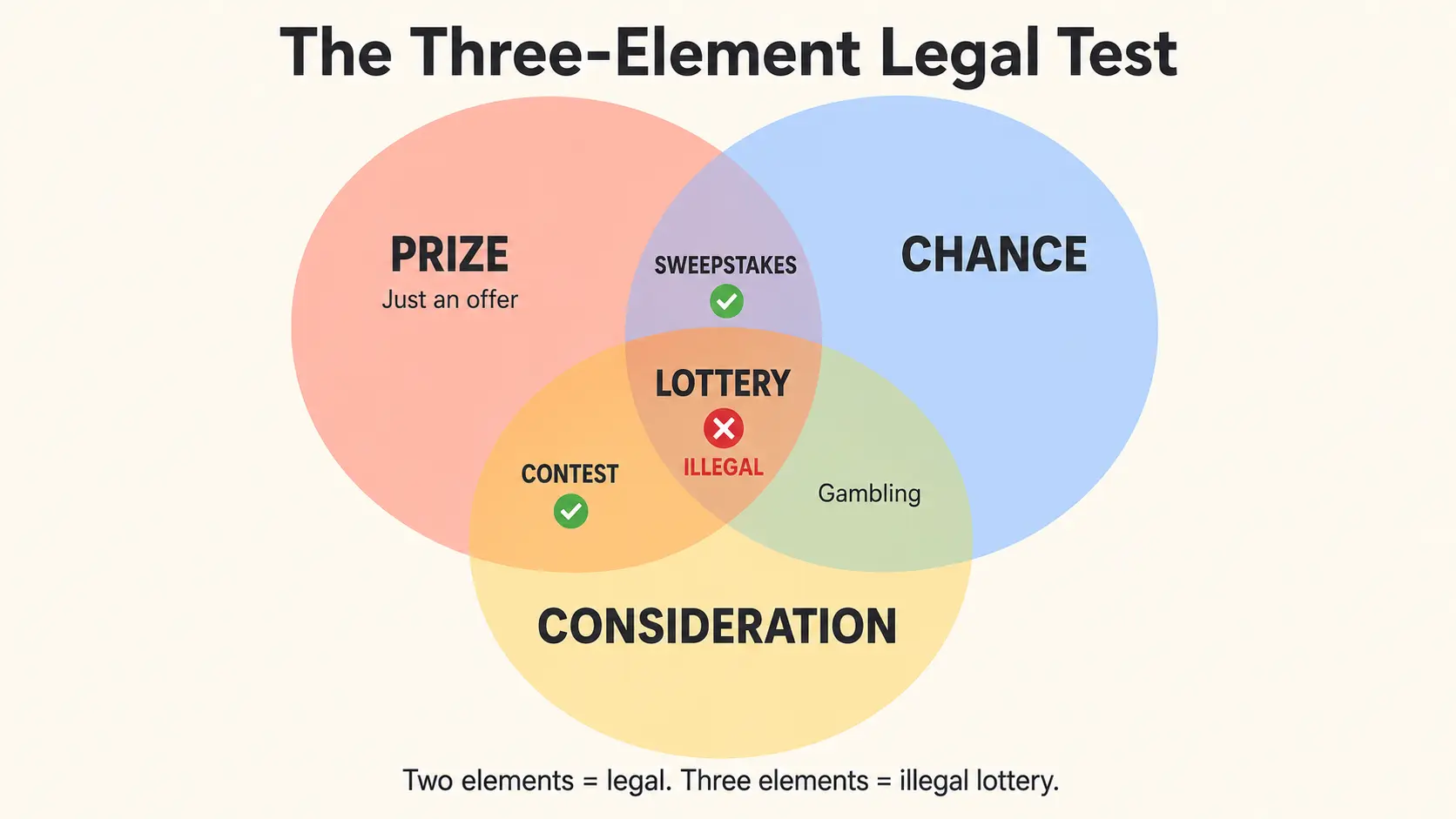
The Three-Element Legal Test
Every promotional drawing in the US is classified by which combination of three elements it contains:
- Prize — anything of value the winner receives.
- Chance — winner selected by random or semi-random method.
- Consideration — entrants give something of value to enter (money, significant time, personal data beyond email).
The combination determines what you're running and whether it's legal:
| Type | Prize | Chance | Consideration | Legal? |
|---|---|---|---|---|
| Sweepstakes | ✅ | ✅ | ❌ | Legal nationwide |
| Contest | ✅ | ❌ | ✅ | Legal with clear criteria |
| Lottery | ✅ | ✅ | ✅ | Illegal (except state-run) |
| Giveaway | ✅ | ✅ | ❌ | Same as sweepstakes |
Two elements are fine. Adding the third element to the wrong pair flips you into illegality. Adding consideration to a sweepstakes (prize + chance) creates a lottery. Adding chance to a contest (prize + skill) creates a lottery. The framework is small, but the consequences of misclassifying are significant.
This article is general information, not legal advice. For prizes over $5,000 or multi-state promotions, consult a promotions attorney before launch.
Sweepstakes: Prize + Chance, No Consideration
A sweepstakes is the legal version of what most people call a "giveaway." Entrants enter for free, a winner is selected randomly, and the prize is awarded. This is the structure 95% of social media promotions should use.
The critical phrase is "no purchase necessary." It must appear in your official rules and be functionally true — meaning if you're requiring purchases for some entrants, you must provide an alternative free entry method (called an AMOE: Alternative Method of Entry) that gives non-purchasers the same chance of winning.
What counts as "consideration" that would disqualify your sweepstakes:
- Requiring purchase of any product
- Charging an entry fee
- Requiring extensive time investment (long surveys, multi-hour activities)
- Requiring sensitive personal data beyond contact information
- Requiring travel or attendance at a physical event for entry
What does NOT count as consideration (safe for sweepstakes):
- Filling out a short form with email and name
- Following a social media account
- Liking, commenting, or tagging a friend on a post
- Subscribing to a free newsletter
- Watching a short video
This is why Instagram and TikTok giveaways nearly always run as sweepstakes — the entry actions (follow, like, tag) don't rise to the level of legal consideration. For the platform-specific rules around how to structure these, see the 2026 Instagram giveaway compliance checklist.
"No purchase necessary" isn't legal jargon. It's the four-word phrase that converts a borderline promotion into a legal sweepstakes.
For high-value sweepstakes (prizes over $5,000), additional registration and bonding requirements kick in for Florida, New York, and Rhode Island. Skip ahead to the state-specific section below.
Contest: Prize + Skill, No Chance
A contest awards a prize based on demonstrated skill — best photo, best caption, best video submission, judged against published criteria. The defining feature: the winner is not random. They're chosen on merit by judges using a stated rubric.
This is why contests can legally charge entry fees in many states. Consideration is permitted because chance is removed. You're paying for the opportunity to compete, not for a random draw.
To stay legal as a contest, three things matter:
1. Publish judging criteria. "Best photo" is too vague. "Photos will be judged on composition (40%), creativity (30%), and adherence to the theme (30%)" is enforceable. Vague criteria expose you to claims that the judging was actually random — which would convert your contest into an illegal lottery.
2. Use qualified judges. For low-stakes contests, employees can judge. For high-stakes contests, use an independent panel — adds credibility and creates an evidence trail if a losing entrant disputes the outcome.
3. Document the judging. Save the scoring sheets, judges' names, and tabulated results for at least 90 days. The most common contest disputes are losing entrants claiming the judging was rigged — documentation is your defense.
Caption contests, photo contests, and video submission contests are the three most common contest formats on social media. Each works when the prize and theme align with what the audience actually wants to create — generic prompts get generic submissions.
Giveaway: The Marketing Term
"Giveaway" is what creators and brands call sweepstakes in casual usage. It carries no specific legal meaning — most US attorneys general treat "giveaway" as a synonym for "sweepstakes" when evaluating compliance.
This is why you can run a "Black Friday Giveaway" without legal exposure as long as the underlying structure is sweepstakes-compliant. The word on the post matters less than the mechanics underneath it.
That said, "giveaway" has one practical advantage for marketing: lower barrier-to-entry framing. "Enter our sweepstakes" sounds bureaucratic. "Enter our giveaway" sounds fun. Both can be the same legal promotion.
When the marketing term and legal structure diverge — calling something a "giveaway" while requiring a purchase — that's where the Austin mattress brand got into trouble. The label doesn't determine the legal status. The mechanics do.
Lottery: The Illegal Cousin
A lottery has all three elements: prize, chance, and consideration. Outside state-licensed programs, lotteries are illegal under federal and state law throughout the US.
The most common ways businesses accidentally create lotteries:
- "Buy this product, get entered to win" without a free entry alternative
- "Donate to our cause for a chance to win" (charitable donations count as consideration)
- "Submit your email and pay a $5 processing fee to enter"
- "Each $10 spent gets you one entry" with no AMOE
Federal lottery statutes (18 U.S.C. §§ 1301-1304) carry criminal penalties for promoters, including fines up to $25,000 and possible imprisonment. State-level enforcement is more common in practice — cease-and-desist orders, refund requirements, and consumer protection settlements.
The fix is almost always the AMOE: add a free entry method that gives non-purchasers an equal chance of winning. Mail-in entries are the traditional AMOE; free online entry forms are the modern equivalent. As long as the free entry path exists and is clearly disclosed, the promotion shifts from lottery to sweepstakes.
When Does Each Format Make Sense?
Strategic fit depends on what you're optimizing for:
Run a sweepstakes when:
- You want maximum entry volume
- Engagement quality matters less than reach
- You're growing followers, building an email list, or boosting algorithmic engagement
- The audience won't put in significant effort for entry
- You want the lowest legal complexity
Run a contest when:
- You want user-generated content you can repurpose
- The audience is creative and motivated to compete
- A judged outcome creates stronger brand engagement than a random draw
- You want to charge an entry fee (some states only)
- The prize value justifies asking for real effort
Use the term "giveaway" in marketing when:
- The underlying structure is a sweepstakes
- You want casual, accessible framing
- The audience trusts the brand enough that "sweepstakes" feels too corporate
The single biggest mistake is running a contest framing ("submit your best photo") with sweepstakes mechanics (random winner from submissions). That mismatch creates legal ambiguity and disappointed entrants who put in effort expecting their skill to count.
State-Specific Requirements for High-Value Promotions
Most social media giveaways under $5,000 in prize value don't trigger state registration. Above that threshold, three states require registration and bonding for any sweepstakes accessible to their residents:
Florida — Sweepstakes with prizes over $5,000 must register with the Florida Department of Agriculture and Consumer Services and post a bond equal to the prize value at least seven days before the promotion starts.
New York — Similar to Florida. Sweepstakes with prizes over $5,000 require registration with the New York Department of State and a bond equal to total prize value.
Rhode Island — Retail sweepstakes (those tied to a retail location) with prizes over $500 require registration. Lower threshold than the others.
If your promotion is open to residents of these states and exceeds the threshold, registration is mandatory — even if you're a small business based elsewhere. The fix is usually one of three options:
- Register in all three states (cost: $100-500 in fees + bond)
- Exclude residents of those states from eligibility (state in official rules)
- Keep the prize value below all three thresholds (cap at $500)
International promotions add another layer. The UK requires "skill-based" framing for most prize promotions. Canada requires a skill-testing question for sweepstakes winners. The EU has GDPR-driven data-handling requirements for entry data. For multi-country giveaways, consult a promotions attorney.
How to Pick a Winner That Holds Up Legally
The winner-selection method is where the documentation requirements meet the technology requirements. For a sweepstakes, your published rules must specify the random-selection method and create an audit trail showing it was followed.
Three methods, ranked by legal defensibility:
Manual draw. Print entries, put them in a box, draw one. Functional for in-person events with witnesses. Indefensible online — no audit trail, no way for losing entrants to verify the draw was random.
Random.org's list randomizer. Free, generates a reproducible seed. Defensible for small sweepstakes if you screenshot the result page. Doesn't handle filtering (eligible-entries-only) — you have to manually curate the entrant list before randomizing.
A dedicated comment picker with proof URL. The Instagram Comment Picker pulls every comment from the giveaway post, applies your entry filters (tag-a-friend requirement, keyword match, duplicate removal), and draws a winner with a cryptographically seeded random algorithm. The seed publishes on a public proof URL anyone can verify — the equivalent of a notarized draw, but free and instant.
For published rules to be enforceable, the method has to be reproducible. A proof URL is reproducible by definition: anyone can rerun the same seed against the same comment pool and arrive at the same winner. That's the audit trail an attorney general would ask for if your promotion were ever challenged.
Pick a sweepstakes winner with a verifiable proof URL. Pull every eligible comment, apply your entry filters, draw a winner with a seeded random algorithm. The proof URL is your legal audit trail — free, no signup required.
→ Open the Comment Picker
Frequently Asked Questions
Is a giveaway the same as a sweepstakes? Legally, yes — in nearly all US jurisdictions, "giveaway" is treated as a synonym for "sweepstakes" when evaluating compliance. The legal status is determined by the mechanics (prize + chance + no consideration), not the marketing label. You can call it a giveaway, sweepstakes, drawing, or promotion — what matters is the underlying structure.
Can I require a purchase if I include "no purchase necessary"? Only if you provide an actual free entry method (called an AMOE) that gives non-purchasers an equal chance of winning. The phrase alone doesn't legalize a purchase-required promotion. The AMOE must be functionally equivalent — same prize, same odds, accessible without buying anything.
Is following an Instagram account considered "consideration"? No. Following, liking, commenting, and tagging friends on social media are not considered legal consideration in any US jurisdiction. They're treated as de minimis effort that doesn't trigger lottery laws. This is why social media sweepstakes are legal even when they require these actions.
What's the difference between a sweepstakes and a raffle? A raffle requires a purchase (you buy a ticket) and is therefore a form of lottery. Raffles are legal only when run by registered nonprofit organizations under specific state-level licensing. Sweepstakes don't require purchase and don't need a license. If someone calls their for-profit promotion a "raffle" and charges for entry, they're running an illegal lottery regardless of what they call it.
Can I run a contest with both judged and random elements? This is the most common legal trap. If you advertise a contest ("best caption wins") but actually pick the winner randomly from submissions, you've created an illegal lottery — you added chance to a contest that already has prize and consideration. Pick one: either fully judged (contest) or fully random with no entry fee (sweepstakes). Hybrid structures need careful legal review.
Do I need to register my sweepstakes with the FTC?
No. The FTC doesn't register or pre-approve sweepstakes. The FTC enforces disclosure rules (like requiring #ad on influencer-promoted promotions) and takes action against deceptive promotions, but there's no federal sweepstakes registry. State registration applies in Florida, New York, and Rhode Island for prizes over the relevant thresholds.
What's the largest sweepstakes prize I can give away without state registration? $500 in Rhode Island (retail context), $5,000 in Florida and New York. Below $500 total prize value, no state registration is required anywhere in the US. Between $500 and $5,000, only Rhode Island retail sweepstakes trigger registration. Above $5,000, plan to register in Florida and New York or exclude their residents.
Are international entries allowed in US sweepstakes? Legally, yes — but each country an entrant lives in adds its own promotion-law requirements. The simplest approach for small promotions is to limit eligibility to US residents only. For multi-country promotions, structure the entry as "skill-based" (a contest with judged criteria) since most countries have more permissive rules for skill-based promotions than for chance-based ones.
Which Format Should You Run?
Most social media promotions should be sweepstakes — prize plus chance, no consideration, "no purchase necessary" in the official rules. It's the legally simplest format, the easiest to scale, and the most familiar to entrants.
Use a contest when the user-generated content is the actual value of the promotion. Use the giveaway label whenever the casual framing fits the brand. Avoid anything that requires purchase without a clear AMOE.
When you're ready to run yours, the full Instagram giveaway playbook covers execution end-to-end, the 2026 Meta compliance checklist covers platform-level rules, and the Instagram Comment Picker produces the verifiable proof URL your published rules will reference. Agencies running multiple promotions a month should compare plans for multi-winner draws, audit logs, and white-label proof pages.
Related Reading
- Instagram Comment Picker — Pick a Verifiable Random Winner — the tool referenced throughout this guide.
- How to Run an Instagram Giveaway: Complete 2026 Guide — the full six-step execution playbook.
- Instagram Giveaway Rules 2026: Complete Meta Compliance Checklist — platform-specific compliance for Meta.
- How to Export Instagram Comments — Complete Guide — save the eligible-entry list as proof.
- Facebook Comment Picker: How to Pick a Random Giveaway Winner — the cross-platform companion to this guide.